Oct 15, 2026
Multi-Zone Inert Gas Fire Suppression: How Directional Valves Protect Multiple Rooms
A CO2 fire suppression system is a carefully engineered automatic gaseous fire suppression system designed to safeguard enclosed spaces as an entire room or a specific object from a potential fire. The system operates on a simple principle: removing oxygen from the protected area to smother the fire. As soon as the system is activated, carbon dioxide is released to reduce the oxygen level below the point where combustion can sustain itself.serve
There are two main configurations for carbon dioxide systems.
As soon as a fire is detected through smoke or heat sensors, the system triggers an alarm and initiates a short pre-discharge delay before the gas is released automatically.
Carbon dioxide extinguishing systems work by displacing oxygen from the fire area to suppress fires through two simultaneous mechanisms. First, since CO₂ is denser than air, it displaces oxygen from the fire area, interrupting combustion. Second, when released, CO₂ expands from a liquid state into gas at extremely low temperatures, rapidly absorbing heat and helping to extinguish the fire more quickly.
CO₂ is stored in high-pressure cylinders as a liquid. The moment it is released, it expands into gas and spreads throughout the protected area. Because it is denser than air, it naturally settles around equipment and in lower areas, which is where most fires tend to start.
CO2 automatic fire suppression systems are designed to protect sensitive equipment in environments where speed, cleanliness, and minimal disruption to operations are priorities.
Because carbon dioxide leaves no residue and does not conduct electricity, it has become the ideal solution for protecting critical infrastructure and special hazards environments where downtime and equipment damage must be minimized. It is particularly ideal for industry segments where conventional water-based systems are simply not an option.
Common applications include:
There are many benefits to using CO2 as the extinguishing agent in an automatic fire suppression system. We’ll go over them below.
CO2 is effective, but it has real limitations that must be taken into account before choosing it as a fire extinguishing agent.
The most serious concern is the life-threatening risk to occupants, with well-documented health effects that cannot be ignored. The concentration required to extinguish a fire (generally around 34% or higher) is well above the threshold considered dangerous to humans. Exposure to CO2 above 9% causes rapid loss of consciousness, and even lower concentrations can cause dizziness and confusion, making self-evacuation more difficult.
This is why strict safety procedures are mandatory with CO2 systems. These include pre-discharge alarms, evacuation timeframes, lockout mechanisms during maintenance, and regular staff training. All of this adds complexity and cost to the overall system, leaving little room for human error. To ensure full compliance and staff readiness, these protocols must be reviewed and practiced regularly. The time required to safely evacuate an area before discharge must also be factored into the system design from the start.
CO2 also requires a confined space to be effective. If the protected area is not sufficiently sealed, the gas dissipates before reaching the concentration needed to extinguish the fire. This makes it less ideal for open or poorly sealed environments, and is one of the reasons why safety planning around the space itself is just as important as the system design.
Finally, monitoring remaining agent levels with CO2 is less straightforward than with other systems. Since it is stored as a pressurized liquid, you cannot simply read a pressure gauge to determine how much is left.
For real-time monitoring of agent levels, the Rotarex Firetec digital monitoring system eliminates any guesswork.
It continuously measures the remaining agent quantity and sends instant alerts if a leak is detected, so you always know your system is ready.
If any of the above limitations apply to your situation, several alternatives exist depending on your environment and priorities.
For occupied spaces or those likely to be occupied, inert gases such as IG-541 (52% Nitrogen, 42% Argon, 8% CO2) or IG-55 (50% Nitrogen + 50% Argon) reduce the oxygen content to approximately 12–13%, a level low enough to extinguish a fire while allowing for survival for a few minutes, thus providing a critical margin if evacuation is not fully complete. This makes them the ideal choice for the industry sectors where people and equipment coexist.
FK-5-1-12 is another clean agent that extinguishes fire without reducing oxygen levels at all, making it one of the safest options for protection of occupied spaces.
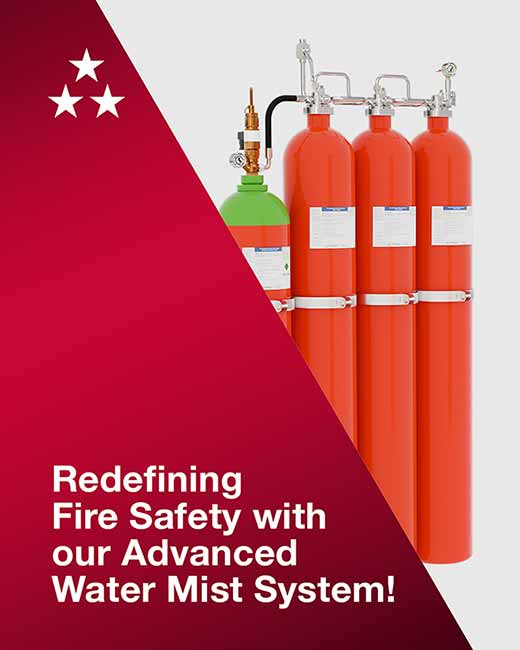
For less confined environments, water mist systems use a fine, high-pressure mist to smother and cool the fire simultaneously. They work regardless of how well the space is sealed, offer effective protection even in the context of industrial processes, and have virtually no impact on the environment.
For facilities where CO2 is not the ideal solution, these alternatives offer the industry a reliable path forward without compromising on safety or performance. Contact us to discuss this with our experts.
Choosing the right fire suppression system is never a one-size-fits-all decision. Carbon dioxide systems offer proven, fast, and clean protection, but they require careful planning, proper engineering, and strict safety protocols to perform as intended. Whether CO₂ is the right fit or not, what matters most is having a system you can rely on when it counts. If you're unsure where to start, our team is here to help you find the solution that fits your facility, your risks, and your people.