Sep 30, 2026
How Much Damage Can an Electrical Cabinet Fire Cause?
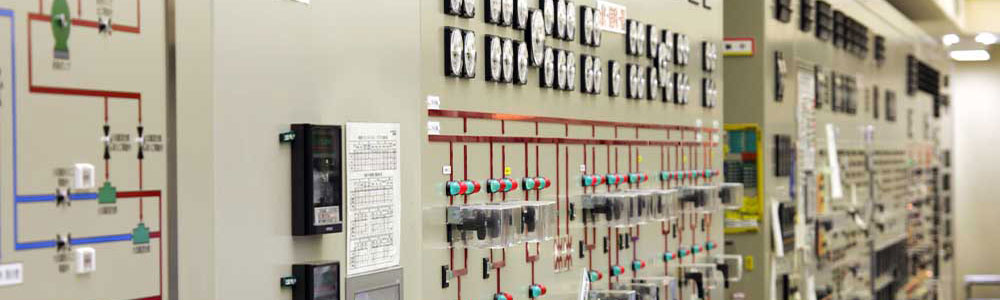
Automatic fire suppression systems help detect and control a fire directly at the risk. Two common approaches are direct and indirect systems, which mainly differ in how the extinguishing agent is discharged.
In this article, we will look at both direct and indirect fire suppression systems, explain how each one works and compare their key differences. We will also cover the main factors to consider when choosing between the two configurations, helping you identify which solution is best suited to the size, layout and fire risk of your electrical panel.
Why electrical cabinets need dedicated fire protection?
What Is a Direct Fire Suppression System?
What Is an Indirect Fire Suppression System?
Direct vs Indirect Fire Suppression: Key Differences
Why chosing FireDETEC systems ?
Electrical cabinets contain cables, circuits, power supplies, relays and other components that can generate heat during normal operation. Electrical faults can be a source of fire inside the cabinet. Because these components are concentrated in a confined space, a single fault can develop into a fire before it is even detected.
If the fire is not brought under control quickly, it can spread well beyond the damaged enclosure itself. The fire can destroy sensitive electrical components, disrupt the operation of machinery or production processes and potentially spread to nearby equipment or flammable materials. In critical installations, this can also lead to significant business interruption and costly downtime.
For this reason, a dedicated fire protection system is essential to detect and suppress a fire as close as possible to its source. The right choice of system depends on the size and layout of the cabinet, the equipment being protected and the specific fire risk. A tailored solution can help limit damage, reduce fire spread and protect both equipment and business continuity.
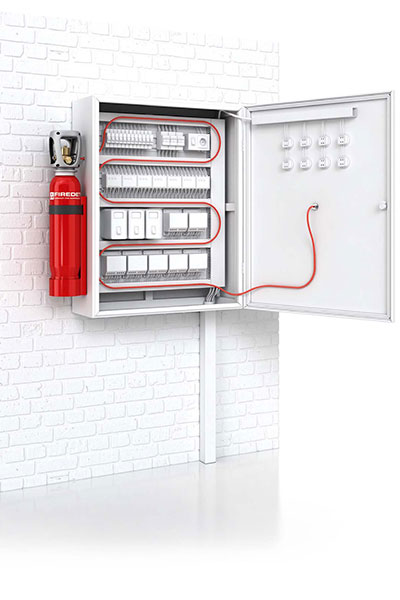
A direct fire suppression system uses a heat-sensitive detection tube to detect a fire and release the extinguishing agent. The tube is installed near the components or areas where a fire is most likely to start, allowing the system to detect heat directly at the source.
When the tube is exposed to a sufficiently high temperature or a flame, it ruptures at the hottest point. This drop in pressure activates the system and allows the extinguishing agent to discharge directly through the opening created in the tube.
Simply put, this same tube serves two functions:
This makes direct fire suppression a compact and localized solution for enclosed applications such as small electrical cabinets, control panels, and machine enclosures.
The operating sequence of a direct system can be summarized as follows:
Heat or flame → detection tube ruptures → pressure drop → discharge of the extinguishing agent through the tube
The detection tube is positioned close to the potential fire risk inside the protected enclosure. When it is exposed to a sufficiently high temperature or direct flame, the tube ruptures at the hottest point. The resulting pressure drop activates the system and initiates the discharge of the extinguishing agent.
Unlike an indirect system, a direct system does not require separate discharge line. Instead, the extinguishing agent travels through the detection tube itself and is released through the opening created at the point of rupture. This means the agent discharge occurs directly where the heat or flame has affected the tube, allowing the suppressant to be delivered close to the source of the fire.
Because the same tubing is used for both detection and discharge, no separate discharge piping or nozzle network is required. It is therefore particularly suitable for small electrical cabinets, control panels and other enclosed applications where space for additional piping and nozzles may be limited.
For suitable applications, a direct fire suppression system can offer several advantages for the safety of electrical installations and sensitive equipment:
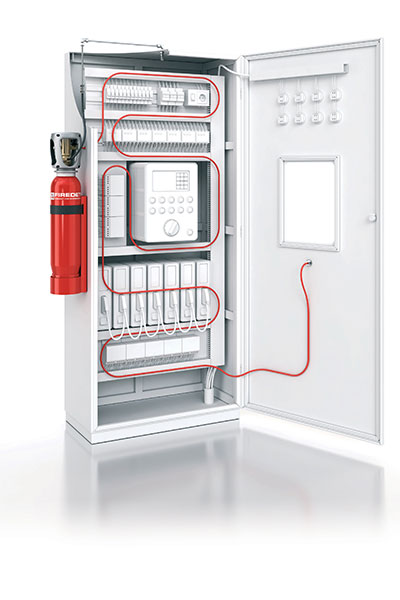
An indirect fire suppression system uses a detection tubing to identify a fire and a separate discharge tube that releases the extinguishing agent into the protected area. This makes it a complete and effective solution for larger or more complex hazards requiring controlled distribution of the agent.
In an electrical enclosure, the detection tube is installed near the components where a fire is most likely to start. Just as with a direct system, when the tube is exposed to sufficient heat or a flame, it ruptures and causes a drop in pressure. This pressure change activates the valve connected to the fire suppressant cylinder. The extinguishing agent is then released through dedicated piping and strategically positioned nozzles.
This separation between detection and discharge allows an indirect system to protect larger electrical cabinets and distribute the extinguishing agent more evenly throughout the protected area.
The operating sequence of an indirect system can be summarized as follows:
Heat or flame → rupture of the detection tube → pressure drop → activation of the valve → release of the extinguishing agent through the piping and nozzle
The detection tube continuously monitors the protected area and reacts when exposed to high temperatures or a direct flame. Once the tube ruptures, the resulting pressure drop triggers the fire suppression system.
The fire suppression agent then flows through a separate discharge line and is released through one or more nozzles located inside the protected space.
Because the detection and discharge functions are separate, nozzle placement can be adapted to the layout of the enclosure and the location of the equipment requiring protection.
For suitable applications, an indirect fire suppression system can offer several advantages in terms of fire safety, flexibility, and equipment protection:
Both direct and indirect systems use heat-sensitive tubes for automatic detection, but they differ in how the extinguishing agent is released into the protected environment. In a direct system, the tube detects heat and also releases the extinguishing agent. In an indirect system, the tube merely detects the fire and activates a separate discharge network equipped with nozzles. Both approaches can be used in a gas fire suppression system, depending on the application.
| Feature | Direct System | Indirect System |
| Detection | Detection tubing | Detection tubing |
| Discharge | Through the tube | Through nozzles |
| Best suited for | Small enclosures | Larger enclosures |
| System design | Simple and compact | More flexible |
FireDETEC® offers a wide range of automatic fire suppression solutions designed to protect electrical cabinets and other sensitive equipment directly at the source of the risk.
The system uses heat-sensitive detection tubes installed near potential ignition points. When exposed to sufficient heat or flame, these tubes trigger the suppression system, which contains the fire before it spreads to surrounding equipment.
One of the key advantages of FireDETEC® is its flexibility. With different detection configurations, direct and indirect systems, and a choice of extinguishing agents, the solution can be tailored to the specific requirements of each application. This makes it possible to take into account the fire hazard, equipment layout, environmental and installation constraints, applicable standards and project budget when selecting the most appropriate protection.
FireDETEC® can therefore be adapted not only to electrical panels, but also to applications such as CNC machines, fume hoods, and other high-value equipment exposed to localized fire risks.
By combining automatic detection, rapid suppression, and a broad range of configurations, FireDETEC® provides a flexible approach to fire protection that can be adapted to the risk rather than applying the same solution to every application. This helps protect critical equipment, improve safety, and reduce the potential impact of damage and business interruption.
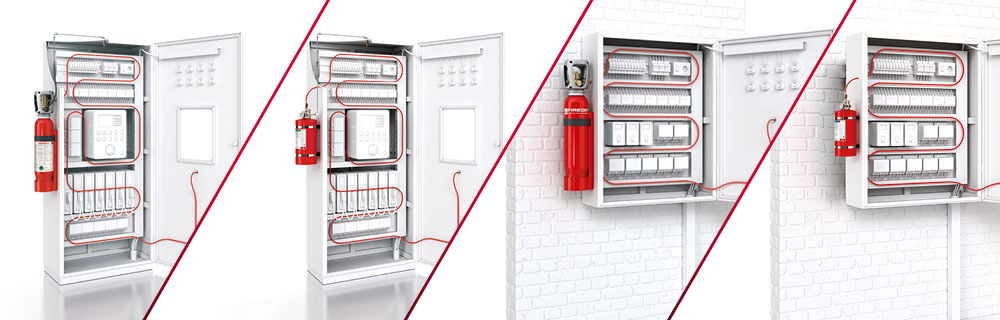
FireDETEC® systems are available in several configurations depending on the discharge method, operating pressure, extinguishing agent, and application:
| Direct | Indirect | |
| Low Pressure |
DLP – Direct Low Pressure The detection tube detects the fire and releases FK-5-1-12 directly through the rupture point. |
ILP – Indirect Low Pressure The detection tube activates a separate discharge circuit, releasing FK-5-1-12 through dedicated nozzles. |
| High Pressure |
DHP – Direct High Pressure The detection tube detects the fire and releases CO₂ directly through the rupture point. |
IHP – Indirect High Pressure The detection tube activates a separate high-pressure discharge circuit, releasing CO₂ through dedicated piping and nozzles. |
These different configurations make it possible to adapt FireDETEC® protection to the specific characteristics of the electrical cabinet, including its size, internal layout, fire hazard and the extinguishing agent required.