Sep 30, 2026
How Much Damage Can an Electrical Cabinet Fire Cause?

Inert gas fire suppression systems are a type of gaseous fire suppression designed to protect sensitive equipment without leaving residue. It works by reducing oxygen inside a protected enclosure until combustion can no longer continue.
When a fire is detected, the extinguishing system releases the selected inert gas through the pipe network and discharge nozzles. The gas spreads throughout the enclosure, displacing oxygen and creating a total flooding atmosphere that extinguishes the fire.
Common inert gas agents include:
The gases are stored in high-pressure cylinders and distributed throughout the protected room, including areas beneath raised floors and around cabinets, when the enclosure is correctly designed and sealed.
Unlike water, foam or dry chemical agents, inert gas systems leave no residue. They are also dry and electrically non-conductive, making them suitable for data centres, server rooms and other areas containing sensitive electrical or electronic equipment.
The main benefits of inert gas systems include reliable performance, clean operation and the ability to protect sensitive equipment with minimal damage. As a form of fire suppression systems, inert gas technology offers several advantages.
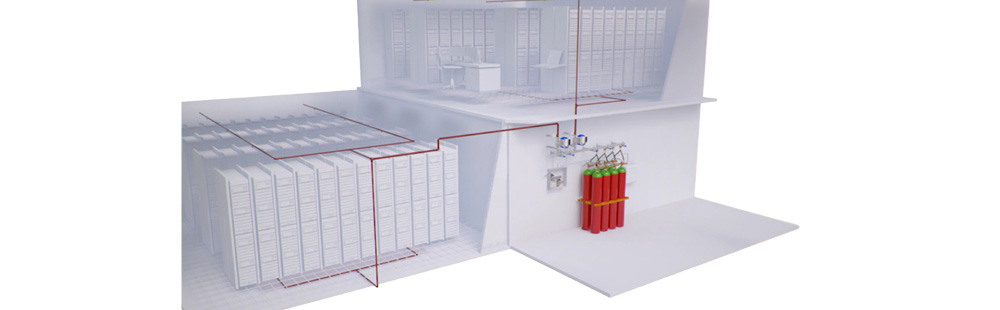
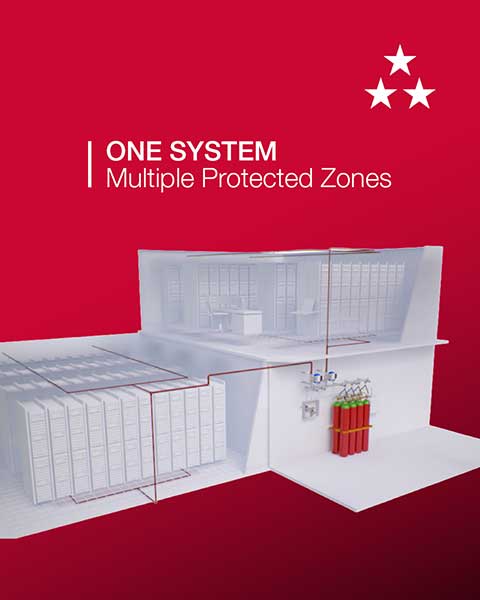
In a standard single-zone system, a cylinder rack protects a single room. If a facility has three rooms that need protection, the traditional approach requires three separate cylinder racks, three piping networks, and three systems to maintain.
The multi-zone fire suppression system works differently. A single cylinder bank stores the inert gas, and directional valves, also known as selector valves, determine which room actually receives the gas when a fire is detected. Each zone is connected to its own detection loop, but all are supplied by the same gas source. The result is a single system that performs the function of several, without compromising protection.
The directional valve, often referred to as a selector valve in the fire protection industry, is actually the technical component that allows multiple rooms to be protected using a single set of cylinders.
When a fire is detected in a specific zone, the control panel identifies the room that triggered the alarm. It then opens the directional valve corresponding to that zone, and only that one. The gas flows through the piping network to the affected room, while the valves leading to the other, unaffected zones remain closed.
This is important for two reasons. First, it prevents the gas supply from being wasted in rooms that do not need it, allowing the system to remain ready to respond if a second incident occurs elsewhere. Second, it ensures complete isolation of each zone: a fire in the server room will not trigger a discharge in the archive room located at the end of the hallway.
When choosing the right fire suppression system, cost and available space are important considerations for fire suppression. A multi-zone system can protect several rooms using a single group of Inerex cylinders instead of separate cylinders for each room.
This configuration offers several advantages:
Each protected room must still be individually designed according to its volume, fire risk and design concentration. The pipe network, flow rate, cylinder capacity and pressure relief requirements must also be calculated to comply with the applicable installation requirements.
A properly designed multi-zone extinguishing system UL listed for the intended application can provide reliable protection while reducing equipment, storage and overall project costs. However, the final design must always be verified to ensure that the shared cylinder bank can meet the required discharge performance for every protected zone.
Multi-zone protection is suitable for facilities containing several rooms or areas that require inert gas fire suppression from a central system. Each protected zone is connected to its own detection system, pipe network and discharge nozzles, while a shared cylinder bank supplies the required quantity of inert gas to the affected room.
Typical applications include:
Each zone is connected to its own detection system, pipe network and discharge nozzles. When a fire is detected, the system releases the appropriate quantity of inert gas only into the affected room.
Multi-zone protection is particularly suitable when several areas have similar installation requirements, but different room volumes, hazards or design concentrations. The system must be properly engineered to ensure the correct flow rate, pressure relief and required quantity of inert gas for each protected zone.
Firetec's Inerex range offers IG-01, IG-100, IG-55 and IG-541 systems, designed for both single-room and multi-zone configurations. Each installation is engineered according to the specific characteristics of the site, from cylinder capacity and pipe network layout to directional valve selection for multi-zone projects.
Whether a facility requires a standalone system or a shared cylinder bank protecting several rooms, Firetec's technical team can help determine the right configuration and calculate the design concentration, flow rate and required quantity of inert gas for each protected zone.